Family business succession instructor qualification course, 5 reasons to expand the scope of corporate advisory experts
We train experts who solve complex succession issues First, it connects individual expertise into a single succession strategy. Second, we expand tax-focused counseling to management strategy. Third, we understand both family succession and corporate succession M&A. Fourth, establish a collaborative corporate advisory system Fifth, prepare for new growth areas in the profession. The training will run from August 20 to September 19, 2026, and will recruit 10 people for each of the two courses. The deadline for submissions is August 18th at 5pm.
This post was auto-translated from Korean.

We train experts who solve complex succession issues
The questions faced in family business succession are not simple. This is because a company's shares, taxes, family relationships, successor capabilities, governance, and corporate value are interconnected. Companies that do not have a successor or have difficulty in internal succession should consider third-party M&A.
The qualification system operated by the Korea Family Business Succession Association and the curriculum of the Korea Family Business Succession Promotion Agency are aimed at nurturing experts who can diagnose these complex problems. The main participants are management advisors, tax accountants, accountants, lawyers, paralegals, administrators, financial and asset management experts, corporate advisory consultants, and corporate practitioners.

[Scene where a family business succession leader, a corporate advisory expert, discusses succession strategies]
First, it connects individual expertise into a single succession strategy.
Family business succession is not complete with just one specific specialty. Tax review must be linked to the shareholding structure, and corporate valuation must be examined together with the successor's financing. Legal review must also take into account family relationships, maintenance of management rights, and interests among shareholders.
Family business succession advisors play the role of designing a succession path appropriate for the company by combining expert knowledge in each field. Rather than being an explainer of individual systems, we are closer to an advisor who structures the company's current status and future options.
Second, we expand tax-focused counseling to management strategy.
Kim Bong-su, chairman of the Korea Family Business Succession Association, says, “Family business succession is not a technique to reduce inheritance tax, but to create a structure so that the company can survive into the next generation.” The key to family business succession is not only tax reduction, but also corporate sustainability and management rights.
The family business succession instructor course covers succession strategy, finance and taxation, governance, family planning, successor development, conflict management and sustainable management. Through this, corporate ownership and management, family and organization can be interpreted within a single strategy.

Third, we understand both family succession and corporate succession M&A.
If there is a suitable successor within the family, long-term training and transfer of management rights are important. On the other hand, for companies where there is no successor or where family members do not agree, a professional management system or third-party M&A may be a more reasonable choice.
The corporate succession (M&A) instructor course covers corporate valuation, sale preparation, acquirer perspective, and transaction structure. Through this, it is possible to compare various succession methods that a company can choose, rather than assuming only family succession.
Dr. Bongsu Kim emphasizes that a good succession strategy does not start with deciding on a specific method in advance. The optimal path must be found after reviewing the company's financial status, shareholding structure, successor's capabilities, founder's intentions, and market conditions.
Fourth, establish a collaborative corporate advisory system
Family business succession is a long-term project that requires the participation of various experts. If tax accountants, accountants, lawyers, management coaches, and financial experts only present their own perspectives, companies may experience confusion.
The role of a family business succession advisor is to organize the company's core tasks and connect experts in each field to coordinate them into a single action plan. The ability to systematically manage corporate status diagnosis, succession roadmap establishment, successor coaching, and conflict prevention is important.
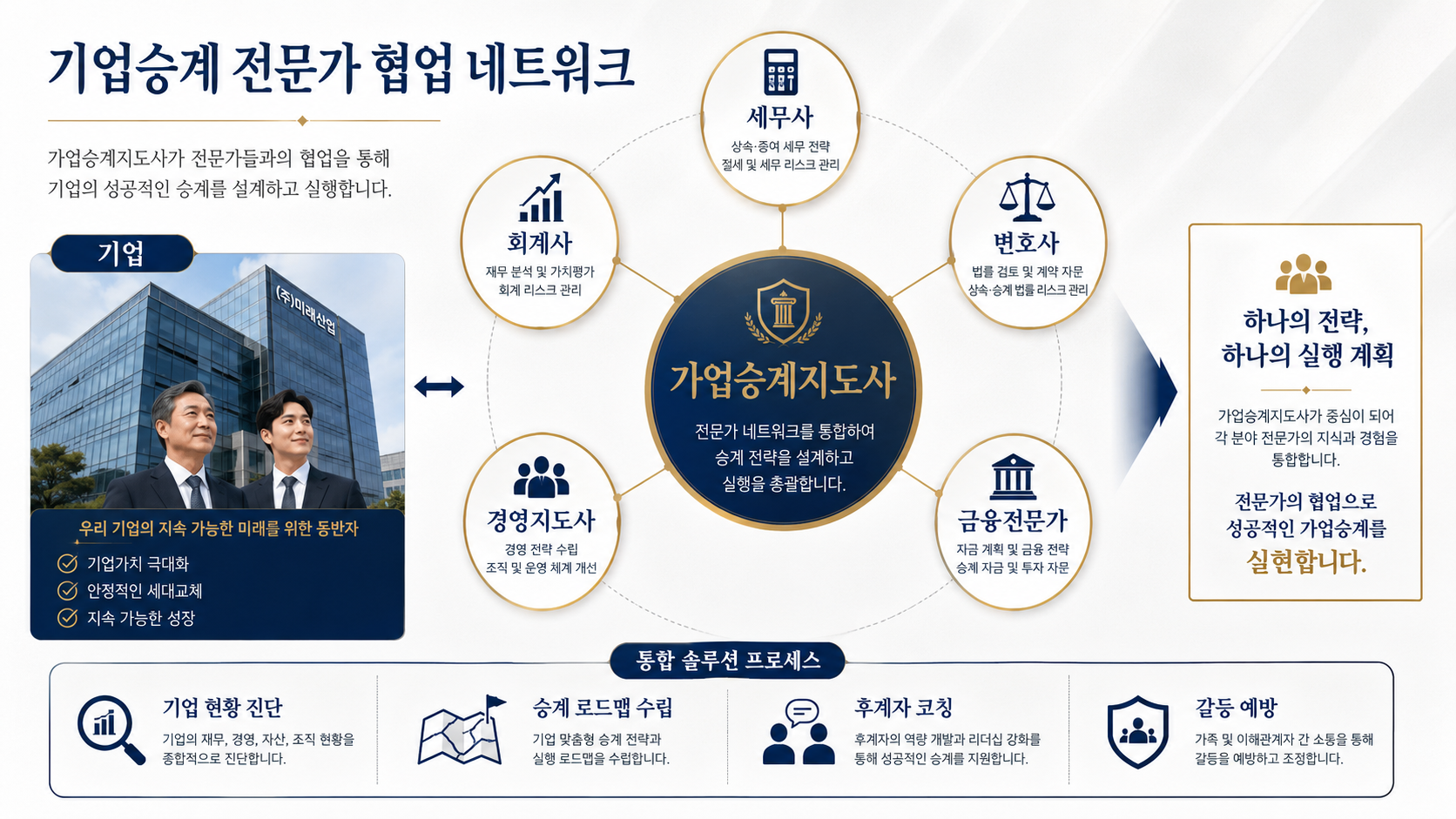
[Corporate Succession (M&A) Expert Collaboration Network]
Fifth, prepare for new growth areas in the profession.
As the founding generation of small and medium-sized companies ages, succession issues are becoming an increasingly important field of corporate advisory. Family business succession is an area with high potential for expansion for qualified professionals who want to provide more in-depth advice to existing customers, consultants and corporate practitioners who want to deal with a company's long-term management issues.
Qualification courses are a systematic starting point for entering a professional field. However, family business succession instructors and corporate succession instructors are registered private qualifications, which are different from nationally recognized qualifications, and acquisition of qualifications does not guarantee employment or income. In the actual field, continuous case studies and collaboration across fields are needed.
Training and qualification examination schedule
Education is From August 20 to September 19, 2026 10 people will be recruited for each of the two courses. The application deadline is August 18th at 5pmno see.
The first day of training will be held face-to-face at the Maekyung Education Center in Chungmuro, Jung-gu, Seoul, followed by online lectures. The qualification test is September 19th from 3pm for 90 minutes It is scheduled to proceed.

Frequently Asked Questions
Q. Can only professionally qualified people participate?
no. Those who wish to build expertise in the field of succession based on relevant experience in corporate advisory, management support, finance/asset management, and corporate practice can also participate.
Q. What roles can I take on once I am qualified?
It can diagnose a company's succession status, compare possible paths such as family succession and M&A, and connect experts in necessary fields. The actual scope of activity will depend on the individual's existing qualifications and experience.
Q. Do I need to prepare a family business succession advisor and a corporate succession advisor together?
If you are focusing on internal succession in a family business and nurturing successors, the family business succession instructor course is suitable. If you want to handle corporate valuation and third-party succession, you can review the corporate succession (M&A) instructor course.
Experts who solve corporate succession issues do not provide all the answers alone. A person who structures complex problems, connects the right experts, and proposes an actionable roadmap.
Please check out this course to see how you can expand your expertise and experience in the field of family business succession.
#Family Business Succession #Family Business Succession Instructor #Corporate Succession Instructor #Corporate Succession M&A #Inheritance Tax #Gift Tax
#Korea Business Succession Association #Family Business Succession Qualification Course #Corporate Advisory #Family Business Succession Consulting
#Professional Education #Management Instructor #Tax Accountant #Accountant #Lawyer
#Corporate Valuation #Successor Education #Family Business Consulting #Dr. Kim Bong-su #Korea Business Succession Agency
#Succession Strategy #Professional Capacity Building #MAndAAdvisor